
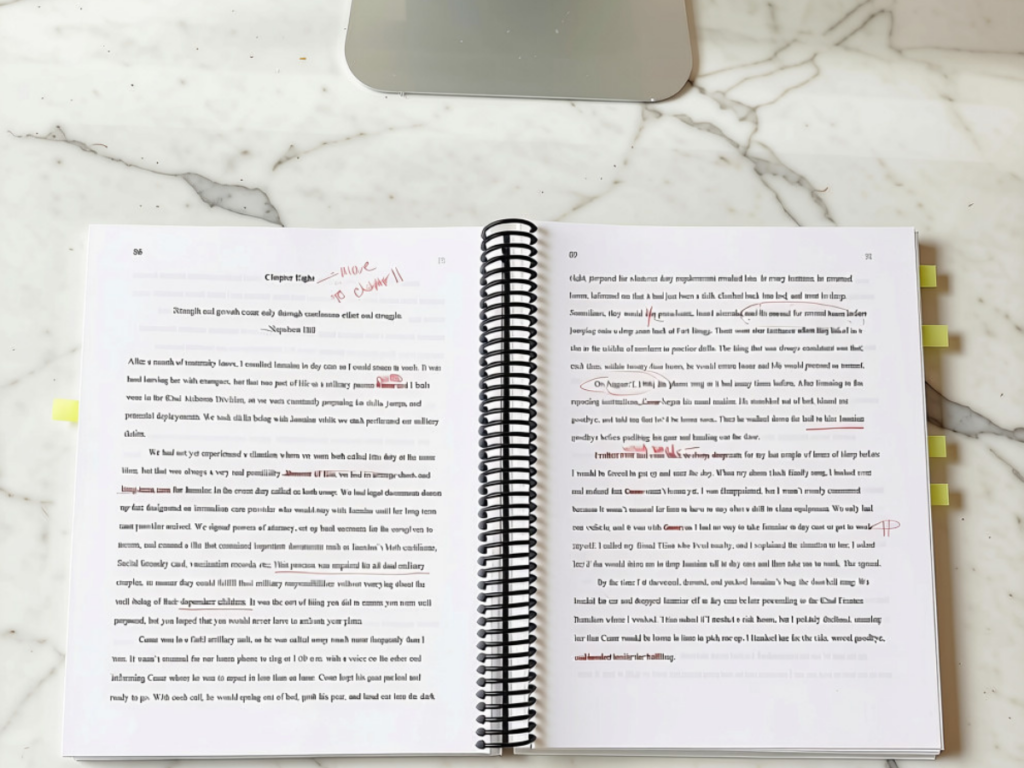
When I decided to write my first book, I had no idea what I was getting myself into.
I knew writing a book would be challenging, and honestly, I expected the writing to be the difficult part. What I underestimated was just how many different kinds of hard were involved in putting my story out into the world. Writing was only the beginning. There was editing, rewriting, querying, rejection, more querying, more rejection, publishing, marketing, and a dizzying number of decisions along the way.
Despite all of that, the manuscript became a book, and I became an author, although not without a few twists, turns, and valuable lessons along the way.
Looking back, there are five things the experience taught me that I’ll carry into every writing journey that comes next.
KNOW WHY YOU’RE DOING IT
Before I wrote the first chapter, I was simply journaling as a way to navigate an unexpected life shift. Every page moved me closer to closure and healing. At some point, I began to realize that these experiences and this story weren’t unique to me. The details might look different, but many people have a version of this story.
I asked myself an important question: If sharing my story could help someone else feel seen or understood, would I be willing to do it? The answer was a very scary yes, and that’s when the idea of writing a book was born.
I knew I wanted to tell a story that might help someone else see possibility in their own life, and that purpose became far more important than I realized it would be. Throughout my writing journey, there were plenty of moments when the process was frustrating, discouraging, or simply exhausting. In those moments, knowing why sharing my story mattered gave me the courage to keep going. I learned that my why wasn’t just the reason I started writing. It was the reason I kept going.
KNOW WHO YOU’RE WRITING FOR
When I first started writing, I wanted the book to be for everyone. Who wouldn’t? The more people who could see themselves in the story, the better, right? I could not have been more wrong.
I quickly discovered that everyone is a very difficult person to write for. Trying to write a story for everyone was starting to become a story for no one. As I kept writing and the manuscript evolved, I started to see the reader I imagined on the other side of the page.
I was writing for someone who knew what it felt like to have life change unexpectedly, to question something they once believed about themselves, or to find themselves nervously standing at the edge of whatever comes next. Once I understood that, the writing became more intimate.
I wasn’t writing for an audience—I was telling a story to a person.
PUBLISHING THE BOOK ISN’T THE FINISH LINE
For a long time, I thought publishing the book would be the finish line. Write the manuscript. Edit it. Find a publisher. Get the book into the world. Done. Not exactly.
One of the biggest surprises for me was discovering how much work begins after the book is finished. Books don’t magically find their readers, and apparently, if you write it, they will come is not a publishing strategy. There were author profiles to build, bookstores and libraries to pitch, events to schedule, podcasts to pitch, social media accounts to create, and LOTS of social media posts to write…and that was just launch week!
While I’m kidding about the last part, I truly learned that writing the book and building a readership are two very different things, and both require considerable attention. It all felt overwhelming at first, but eventually I found my rhythm. Now, when a reader tells me what the story meant to them, I know it was all worth it.
Publishing my book wasn’t the finish line. It was just the end of part one.
EVERYTHING TAKES LONGER THAN YOU THINK
1,238 days, or 40 months. That’s how long it took to write and publish my book. I knew writing and publishing a book would take time, but I had no idea it would take that long.
My first writing plan had me completing the manuscript in eight months, followed by three months of editing, a month of proofreading, six months to find a publisher, and another five months to get the book published. My 22-month expectation became 40 months in reality. I spent roughly a year writing the manuscript, another year editing and rewriting it, and nearly another year querying agents and working through the publishing process. There were stretches when it felt like I was making tremendous progress and others when I wondered whether the universe was playing a funny joke. Me, a person who built a career around accomplishing goals, running nearly two years behind schedule. I have to admit, that’s pretty funny.
Publishing taught me a different relationship with time. Some things simply couldn’t be rushed. The story needed time to evolve, feedback required time to absorb, and more than once I discovered that something I thought was finished was not. Eventually, I stopped measuring progress by how quickly I was moving and started paying more attention to whether the book was getting better.
Looking back, I’m grateful it took longer than I expected. The book I eventually published was not the book I would have published a year earlier, and I’m very glad I didn’t get the chance to prove that. Sometimes taking longer isn’t a sign that something has gone wrong. Sometimes it’s simply how long the work takes.
REJECTION ISN’T NECESSARILY A VERDICT ON THE WORK
Every rejection hurt. I wish I could say that after receiving enough of them I became accustomed to it, but I didn’t. I had spent years working on something deeply personal, and every time an agent or publisher passed on it, I had to remind myself that it wasn’t personal—they didn’t know me. I also knew that a query letter, synopsis, or sample chapter couldn’t encompass the whole of my book.
Over time, I learned to see rejection differently. There are countless reasons an agent or publisher might pass on a manuscript. Timing. Marketability. Their current list. Personal taste. Sometimes the answer is simply that the book isn’t the right fit for them. I stopped treating every no as an indictment of my work and began to consider another possibility: if my book wasn’t right for them, perhaps they weren’t right for my book either.
That shift in perspective mattered. I didn’t need everyone to believe in my story. I only needed to remain clear about why I believed in it.
Sharing my story mattered too much to let rejection be the reason I stopped. Your story may matter that much too. So, keep writing. I look forward to reading it one day.